

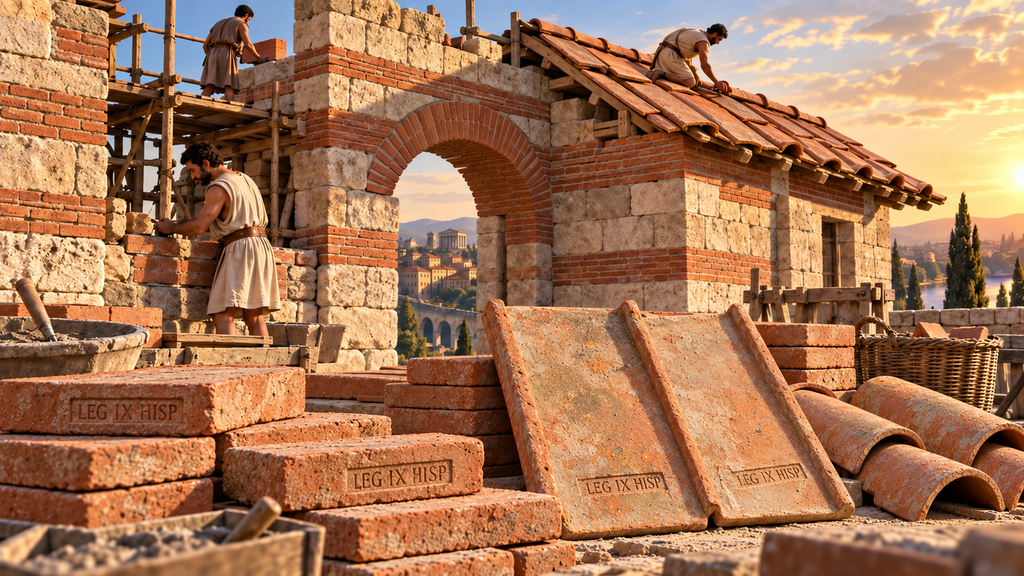
Fired brick was one of the most important and versatile materials in Roman construction. Its regular shape, relatively predictable strength, and ease of production made it suitable for a wide range of architectural purposes, from ordinary walls to complex vaulted structures and sophisticated heating systems.
Unlike modern standardised bricks, Roman bricks were produced in a wide variety of shapes and sizes. Large flat bricks could be used whole or cut into smaller triangular or rectangular pieces, depending on the type of masonry. Specially shaped ceramic elements were also manufactured for particular architectural needs, including arches, vaults, columns, floors, wall linings, and hypocaust heating systems.
Brick was not used only as a primary wall-building material. It was frequently combined with stone and mortar in mixed masonry. Horizontal brick courses could help level irregular stonework, strengthen long walls, reinforce corners, or create more regular construction lines. Bricks were also especially useful for forming arches above doors and windows, where their consistent shape made it easier to create stable curved structures.
In some Roman buildings, brickwork was also used as a visible architectural element. Carefully arranged courses could give walls a regular and highly ordered appearance, while in other cases the brick structure was later covered with plaster, stone facing, or decorative finishes.
A distinctive type of Roman ceramic building material was the tegula, a large flat roof tile with raised edges along its sides. Tegulae were laid in overlapping rows, while the joints between them were covered by curved tiles known as imbrices. Together, the tegula and imbrex formed the characteristic Roman tiled roof, a system that was durable, efficient, and widely used throughout the Empire.
Tegulae, however, had a much broader range of uses than roofing alone. They could be reused or specially employed in floors, drainage channels, graves, wall construction, and various hydraulic structures. Their large, flat surfaces made them especially practical wherever a relatively regular ceramic slab was needed.
Roman ceramic building materials are also important archaeological evidence because many bricks and tiles bear stamps, inscriptions, or marks identifying the workshop, estate, construction unit, or military formation that produced them. These stamps can provide valuable information about production, distribution, military organisation, and the chronology of a building phase.
In military centres, legions and auxiliary units often organised their own production of bricks and roof tiles. Such finds do more than identify the material itself: they directly connect the construction of buildings, roads, drainage systems, and fortifications with the military unit responsible for maintaining the site.
Because brick was durable, adaptable, and easy to combine with stone, mortar, and concrete, it became one of the defining materials of Roman architecture. Its use reflects the practical and highly organised approach of Roman builders, who selected materials not only for appearance, but also for structural efficiency, speed of construction, and long-term durability.