

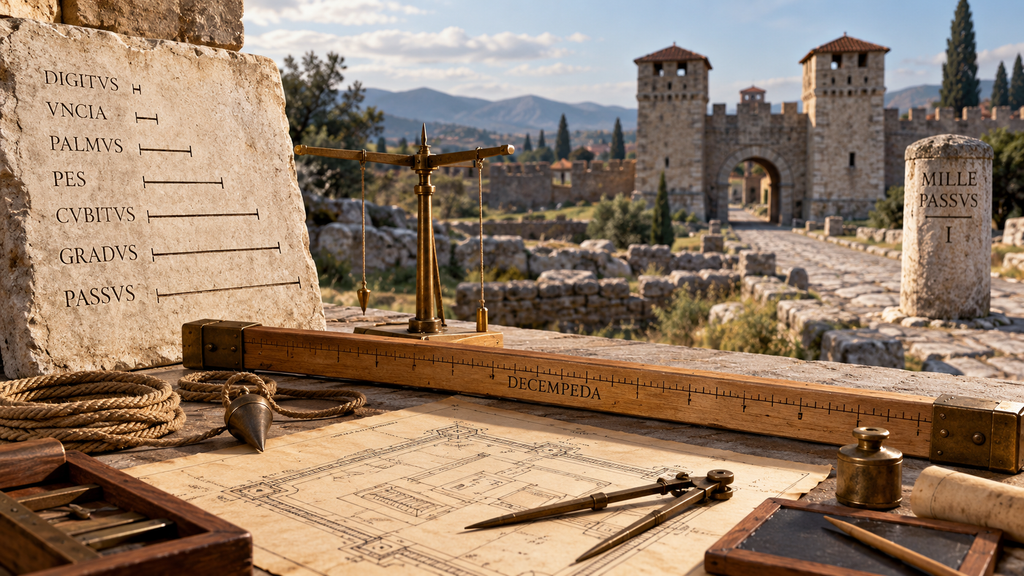
The Roman Empire extended across an enormous territory, from Britain to North Africa and from Hispania to the Middle East. For such a vast system to function effectively, it was necessary to have relatively standardised units for length, area, volume, and weight.
The Roman system of measurement was not decimal like the modern metric system. Its basic units were derived from practical dimensions of the human body – the width of a finger, the palm, the foot, the cubit, and the pace. Larger units were created by multiplying these basic measures.
In architecture and military construction, the most important unit was the Roman foot – pes.
The Roman Foot – pes
One Roman foot measured approximately 29.6 cm. The exact value could vary slightly depending on the period and region, but for reconstructions of Roman buildings a value of around 296 mm is most commonly used.
The Roman foot was the basic unit of measurement in architecture. The dimensions of walls, rooms, doors, towers, streets, and other architectural elements can often be expressed as simple multiples of Roman feet.
For example, a wall approximately 3 m thick would correspond to about 10 Roman feet, while a tower around 6 m wide would correspond to approximately 20 feet.
Such relationships can be extremely useful today when creating archaeological and 3D reconstructions.
From the Finger to the Foot
The Roman foot was divided into smaller units. One of the basic units was the digitus, or finger-width.
| Roman measure | Relation | Approximate modern value |
|---|---|---|
| Digitus – finger | 1/16 of a foot | 1.85 cm |
| Uncia – inch | 1/12 of a foot | 2.47 cm |
| Palmus – palm | 1/4 of a foot | 7.4 cm |
| Pes – foot | basic unit | 29.6 cm |
| Cubitus – cubit | 1.5 feet | 44.4 cm |
| Gradus – step | 2.5 feet | 74 cm |
| Passus – double pace | 5 feet | 1.48 m |
It is particularly interesting that 16 digiti made up one Roman foot. For this reason, many smaller architectural dimensions can be expressed very naturally in digiti.
The Roman Pace and Mile
Greater distances were measured in paces.
The Roman passus did not represent a single ordinary step, but a double pace, meaning the distance between two successive contacts of the same foot with the ground. It measured five Roman feet, approximately 1.48 m.
One thousand such paces made up a Roman mile – mille passus.
1 Roman mile = 1,000 passus = 5,000 Roman feet ≈ 1,480 m.
The word “mile” itself derives from the Latin mille, meaning one thousand.
Along Roman roads, stone milestones – miliaria – were erected to indicate distances between cities and other important locations.
Measures in Roman Military Architecture
Regular modular relationships frequently appear in Roman military camps and fortifications.
The widths of gateways, the thickness of ramparts, the dimensions of towers, and the distances between individual structures could be determined in whole Roman feet or in simple fractions of them.
For example:
10 Roman feet ≈ 2.96 m
20 Roman feet ≈ 5.92 m
30 Roman feet ≈ 8.88 m
50 Roman feet ≈ 14.80 m
100 Roman feet ≈ 29.60 m
When an archaeologically measured value comes close to one of these regular figures, it is possible to consider whether the Roman builder originally used that particular measurement.
This is especially interesting when reconstructing Roman ramparts and towers. A dimension measured in the field at, for example, 5.8–6 m may correspond to a planned measurement of approximately 20 Roman feet.
Decempeda – the Measure of Roman Builders
For builders and land surveyors, the decempeda, a measuring rod ten Roman feet long, was especially important.
Its length was approximately 2.96 m.
Such a measure was very practical when laying out foundations, walls, streets, and plots of land. Roman surveyors – agrimensores or gromatici – used standardised instruments and measurements to determine directions, angles, and distances with considerable precision.
This is one of the reasons why Roman urban planning and military architecture often display a high degree of geometric regularity.
Measures of Area
Roman units were not used only for measuring length. Special units connected to the basic units of length were also used for land and agricultural areas.
One of the best known was the iugerum, approximately the area that a pair of oxen could plough in one day.
One iugerum measured about 2,520 m², or slightly more than one quarter of a hectare.
These units were extremely important for land division, taxation, and the organisation of colonies.
Weight
The basic Roman unit of weight was the libra, or Roman pound, weighing approximately 327 grams.
The libra was divided into 12 parts – unciae. This is the origin of the term “ounce”, which later entered many European systems of measurement.
One Roman uncia weighed approximately 27 grams.
The same term, uncia, was also used for one twelfth of a foot, showing that the Romans applied the same mathematical principle of division to different types of measurement.
Roman Measures and the Reconstruction of Roman Buildings
For modern reconstructions of Roman architecture, knowledge of Roman measurements can be extremely useful.
Archaeologists today measure surviving structures in metres and centimetres, but Roman builders did not think in the metric system. When archaeological measurements are converted into Roman feet, very clear relationships sometimes appear that are not immediately obvious at first glance.
A wall measuring 2.95–3.00 m may correspond to 10 feet, a structure measuring approximately 8.9 m to 30 feet, and a distance of around 29.6 m to 100 Roman feet.
For this reason, when creating our 3D models of Roman fortifications, we do not consider archaeological dimensions only in metres. Whenever possible, we also examine how they fit into the Roman system of feet.
This approach can help reveal, behind modern archaeological measurements, the original logic of the Roman builder.