

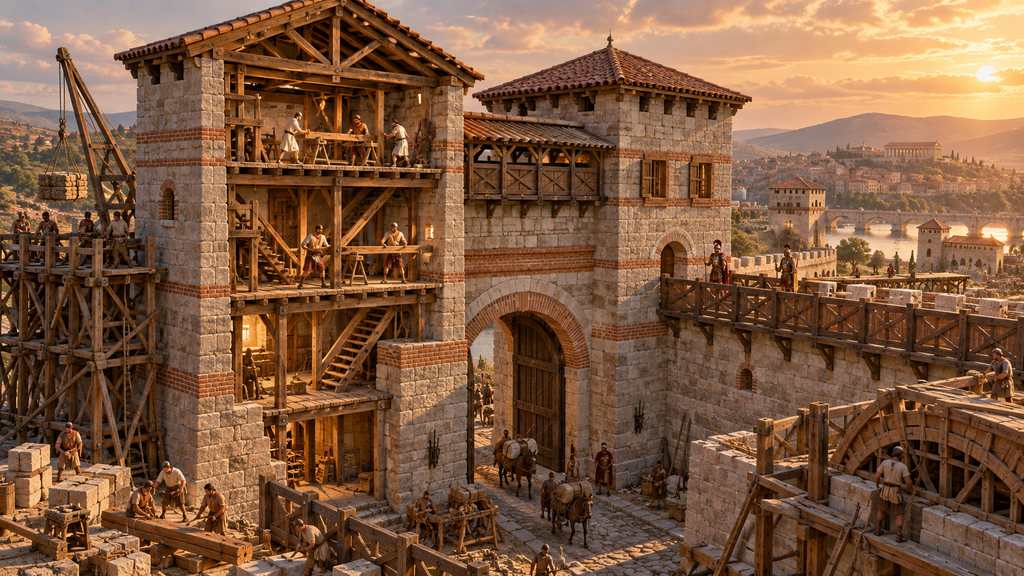
Although it is often almost invisible in the archaeological record, timber was one of the most important building materials of the Roman Empire. It was widely available, relatively easy to work, and could be used in almost every type of structure, from simple military installations to large public buildings.
Timber was essential for roofs, intermediate floors, staircases, doors, shutters, floorboards, scaffolding, bridges, gates, defensive platforms, and internal partitions. It was also used for temporary construction works, including formwork for arches and vaults, lifting devices, support structures, and access platforms during building works.
In Roman military architecture, wood played an especially important role. The earliest phases of many forts and camps were constructed largely from earth and timber, because these materials allowed defensive structures to be built quickly. Ramparts could be formed from earth supported by timber frameworks, while towers, gates, barracks, storehouses, and internal buildings were often made almost entirely of wood.
As military bases became more permanent, many of these timber structures were gradually replaced by stone. However, this did not mean that wood disappeared from Roman fortifications. Even when the walls, towers, and gates were constructed in stone, timber remained essential for the internal parts of the buildings.
Monumental stone gates, for example, could contain wooden floors between storeys, staircases, roof structures, doors, shutters, internal galleries, and defensive platforms. Walkways along the tops of ramparts may also have relied partly or entirely on timber construction. Large gate leaves themselves were normally made of heavy wooden planks reinforced with metal fittings.
Roofs required substantial quantities of timber. Beams, rafters, and other structural elements formed the framework upon which ceramic roof tiles such as tegulae and imbrices were placed. In wider buildings, carefully designed timber trusses allowed roofs to span considerable distances without requiring continuous internal walls.
Wood was equally important outside military architecture. Roman houses, workshops, warehouses, temples, baths, and public buildings all depended on timber for structural and functional elements. Bridges could contain extensive wooden superstructures, while harbour installations, quays, and foundations sometimes used timber piles driven into soft or waterlogged ground.
The major difficulty for archaeologists is that timber usually survives far less well than stone, brick, or mortar. In ordinary soil conditions, wooden beams and floors decay almost completely. What remains may be limited to postholes, stains in the soil, impressions in mortar, iron nails, metal fittings, or cavities where wooden elements once existed.
Under exceptional conditions, however, timber can survive for centuries or even millennia. Waterlogged environments, wells, riverbeds, and soils without sufficient oxygen can preserve wooden structures surprisingly well. Such discoveries provide valuable information about Roman carpentry, construction techniques, jointing methods, and the dimensions of structural elements.
The disappearance of timber presents a particular challenge for modern archaeological reconstruction. A stone foundation or wall may survive for almost two thousand years, while everything that once stood above it in wood has vanished. Archaeologists and reconstruction specialists must therefore combine physical evidence with comparisons from better-preserved sites, architectural logic, structural requirements, and knowledge of Roman building techniques.
For this reason, when reconstructing a Roman fortification, the surviving stone walls represent only part of the original building. Floors, stairways, roof frames, doors, defensive platforms, and many internal structures may originally have been made of timber, even though no visible trace of them remains today.
Understanding the importance of wood is therefore essential for imagining Roman architecture as it actually existed: not as a collection of bare stone ruins, but as complete buildings in which stone, brick, mortar, and timber worked together as a single construction system.